
The Flawed Intern: 4 Reasons Schools Must Embrace AI (Not Ban It)

Updated: Sep 3
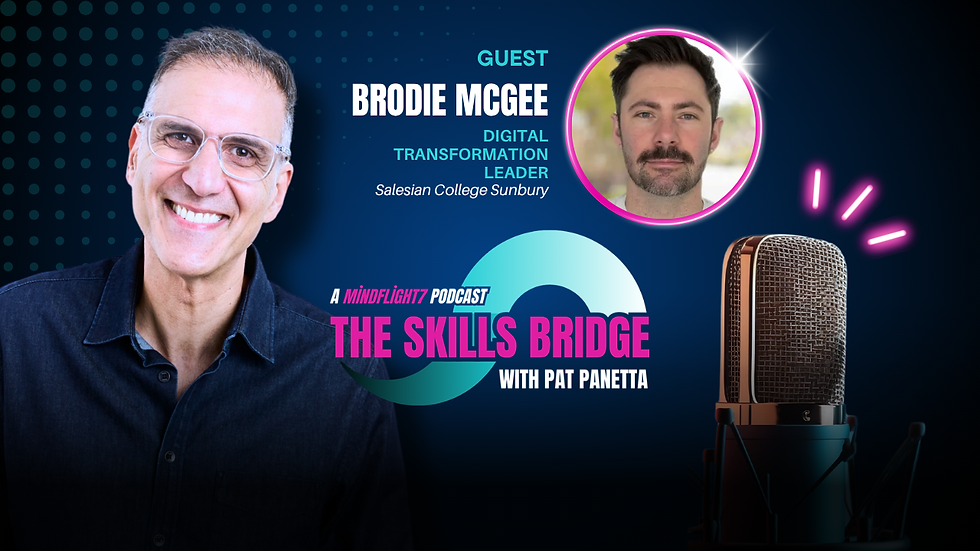
When generative AI first hit the mainstream, many schools panicked and built firewalls to block it. But as Episode 2 of The Skills Bridge reveals, trying to ban the future is a massive disservice to our students.
In this episode, host Pat Panetta sits down with Brodie McGee, Digital Transformation Leader and XR researcher at Salesian College Sunbury. Brodie’s school took a radically different approach to the AI boom: instead of fighting the technology, they built their own heavily guardrailed AI systems to force deeper critical thinking. His take? AI isn't going anywhere, and banning it only guarantees your students will fall behind.
If schools want to prepare students for a workforce that demands technological fluency and critical analysis, they need to stop offloading the problem and start managing the tools. Here are four of Brodie’s most powerful insights.
1. Shift from Spoon-Feeding to Socratic Questioning
The biggest fear among educators is that students will use AI to shortcut their learning and write their essays for them. Brodie’s team solved this not by banning AI, but by changing how it responds.
What this looks like in practice: Build custom AI tools with strict guardrails. Salesian College built a custom chatbot with a default "Socratic mode." Instead of spitting out an answer when a student asks a question, the bot asks a question back. It challenges the student’s current understanding, teases out concepts, and forces them to engage critically with the material rather than just copying and pasting a final result.
2. Use AI to Give Teachers Their Weekends Back
A major pushback against new EdTech is that it simply creates more administrative work for already exhausted teachers. Brodie argues that if an AI system isn’t saving a teacher time, it isn't being used correctly.
What this looks like in practice: Teachers can train custom chatbots on their specific course material. At the end of a lesson, teachers drop their lesson plans, study designs, and even photos of the whiteboard into the bot. If a student misses a class or needs to revise, they ask the bot—which responds exactly how that specific teacher would. By offloading repetitive, base-level questions, teachers are freed up to focus on higher-level mentoring and human connection.
3. Teach AI Literacy as a Core Career Skill
Students are understandably anxious about the rapid pace of technology and the fear that AI might replace human workers. However, Brodie highlights a crucial reality for the 2030 workforce: AI won’t take your job, but a person with AI skills will.
What this looks like in practice: Bring AI ethics, safety, and limitations directly into the classroom curriculum. Discuss real-world AI developments (such as AI sandbox testing) and empower students to understand how these systems work under the hood. When students know how to validate, manage, and critique the machine's mistakes, they transform from passive consumers into highly employable critical thinkers.
4. Merge AI Tutors with Distraction-Free VR
Learning isn't just cognitive; it is an embodied experience. While flat screens and laptops are full of notifications and digital noise, Brodie’s XR research points to a future where AI and Virtual Reality (VR) converge to create the ultimate learning environment.
What this looks like in practice: Imagine dropping a student into a distraction-free, fully immersive VR environment - like walking through ancient Rome or a virtual science lab - with a custom AI co-pilot there to guide them and answer questions in real-time. This combination expands the classroom far beyond its physical walls, providing profound, engaging learning experiences, particularly for disadvantaged or regional students.
The Bottom Line
Parents want their children to step into the real world with security and confidence. To deliver that, schools must recognise that the future workforce runs on AI. By moving past the fear and utilizing custom, pedagogy-driven AI tools, schools can protect academic integrity, reduce teacher burnout, and build the adaptable, critical thinkers the modern economy desperately needs.
🎙️ Listen to the full conversation with Brodie McGee on Episode 2 of The Skills Bridge:
Stop fighting the technology and start leveraging it. Mindflight7’s SmartHub unifies lesson planning, assignments, and grading using AI, allowing educators to focus on what matters most - human connection. Explore our SmartHub and book a demo today.


